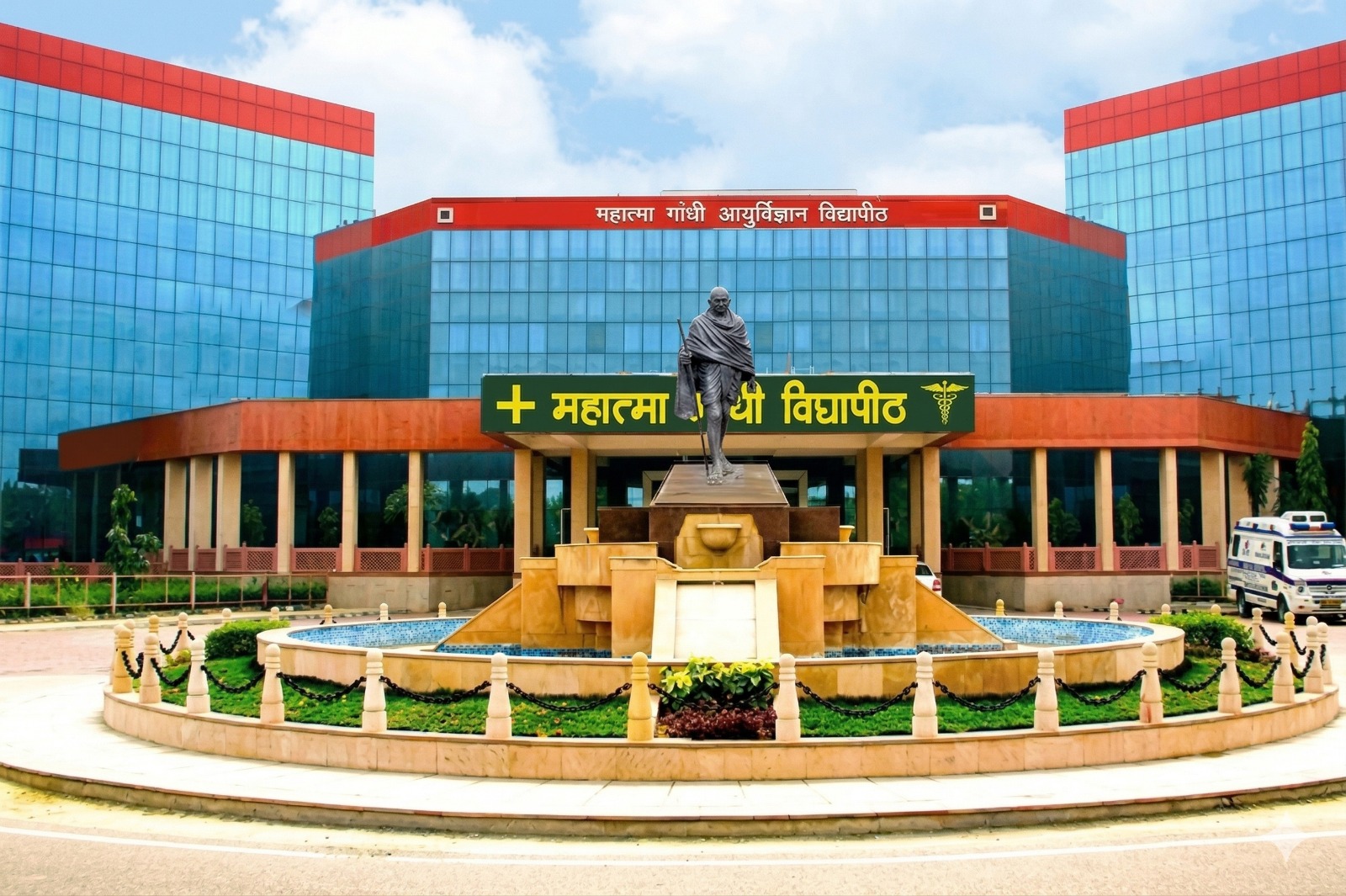
Mahatma Gandhi Ayurvigyan Vidyapeeth (MGAV) is an educational institution located in Nagpur, Maharashtra, India. According to its official website, the institution focuses on education, training, research, and community development in naturopathy, yoga, traditional health practices, allied healthcare sciences, and vocational education. Its stated educational philosophy combines traditional Indian knowledge systems with contemporary teaching methods, practical learning, professional skills, and ethical values.
Located in the Bahadura area near Dighori Naka on Umred Road, the Vidyapeeth aims to make educational and skill-development opportunities accessible to learners from urban, semi-urban, and rural communities.
Official website: https://mgavidyapeeth.com/
About Mahatma Gandhi Ayurvigyan Vidyapeeth
Mahatma Gandhi Ayurvigyan Vidyapeeth describes itself as an independent educational institution committed to preserving India's traditional health knowledge while developing professional competencies through structured learning and practical exposure.
The institution's stated objectives include promoting education in traditional and integrative health sciences, encouraging research and innovation, developing skilled and socially responsible learners, and supporting community wellness through education and public awareness.
Its educational approach emphasizes a combination of theoretical knowledge, practical training, skill development, research orientation, and community-based activities. The institution also highlights the importance of critical thinking, professional ethics, problem-solving abilities, and personal development.
Vision and Mission
The Vidyapeeth's stated vision is to develop into a respected centre for education, training, research, and innovation in traditional and integrative health sciences. It seeks to connect India's traditional knowledge with contemporary learning and responsible professional practices.
Its mission includes:
Preserving and promoting India's traditional health knowledge.
Supporting accessible and affordable education.
Developing competent and compassionate professionals.
Encouraging research, innovation, and evidence-informed practices.
Promoting preventive health, natural living, and community wellness.
Contributing to society through education, vocational skills, and public awareness initiatives.
These objectives reflect the institution's stated commitment to educational development, ethical conduct, and community service.
Gandhian Values and Educational Philosophy
The institution draws inspiration from the ideals of Mahatma Gandhi, particularly truth, non-violence, self-reliance, inclusiveness, and service to humanity.
Its educational philosophy highlights five principles:
Satyagraha: Encouraging truth, honest inquiry, disciplined learning, and academic integrity.
Ahimsa: Emphasizing compassion and responsible approaches to healthcare and well-being.
Sarvodaya: Promoting inclusive educational opportunities and the welfare of different sections of society.
Swadeshi: Respecting indigenous knowledge, local resources, and sustainable community practices.
Seva: Encouraging students and professionals to contribute to society through service and responsible conduct.
Through these principles, the institution aims to encourage the development of knowledgeable professionals who value both professional competence and social responsibility.
Courses and Academic Programs
The official website lists programs across naturopathy, yoga, alternative health education, allied healthcare, paramedical training, hospital administration, and vocational education. Course availability, eligibility, duration, and admission requirements may differ by program.
Naturopathy and Yoga
Programs listed in this category include:
Bachelor of Naturopathy and Yoga Sciences (BNYS)
Diploma in Naturopathy and Yoga Sciences (DNYS)
MD in Naturopathy and Yoga Sciences
Postgraduate Diploma in Yoga Science
Postgraduate Diploma in Yoga Therapy
Postgraduate Diploma in Yoga and Naturopathy
Postgraduate Diploma in Acupuncture
These programs relate to the study of yoga, naturopathy, traditional wellness practices, and associated health sciences. Applicants should verify the exact qualification requirements and the professional scope of each program before enrolling.
Paramedical and Allied Healthcare Programs
The institution's website also lists programs in technical and allied healthcare fields, including:
Diploma in Medical Laboratory Technology
Diploma in Radiology Technology
Diploma in Medical Imaging Technology
Diploma in X-Ray Technology
Diploma in Radiology and Imaging Technology
Diploma in CT Scan Technology
Diploma in ECG Technology
Diploma in Emergency Medical Technician training
Diploma in Health Sanitary Inspector training
These subjects are associated with technical support and operational roles in healthcare settings. The applicable eligibility criteria, practical training arrangements, recognition, and employment requirements should be confirmed for each course.
Hospital Administration and Other Programs
The website additionally lists programs such as:
Master of Hospital Administration (MHA)
Community Medical Service and Essential Drugs (CMS & ED)
Bachelor of Electro-homeopathy Medicine and Surgery (BEMS)
Diploma in Electro-homeopathy Medicine and Surgery (DEMS)
Postgraduate diploma programs
Certificate and vocational training programs
Ayurvedacharya Guru-Shishya program
Program names and availability are subject to the institution's current academic offerings. Prospective students should consult the official course pages for the latest details.
Learning Environment and Student Development
Mahatma Gandhi Ayurvigyan Vidyapeeth states that it seeks to provide a learner-centred environment supporting academic study, practical training, innovation, research, and personal development.
Its stated educational approach includes theoretical instruction, practical exposure, professional skill development, ethical education, and community-based learning.
The institution also identifies academic guidance, leadership opportunities, cultural activities, wellness initiatives, and community service as elements of student development. These activities are intended to help learners build professional competence while developing an understanding of their responsibilities towards society.
Students considering a program should request specific information about available laboratories, clinical or practical placements, faculty qualifications, training facilities, and assessment procedures.
Admission Procedure
The institution's website provides an admission process for prospective students. Applicants can begin by reviewing the available programs and the corresponding eligibility requirements.
The general steps described on the admission page include:
Visit the official website and review the selected course.
Download or obtain the admission form.
Complete the application with accurate personal and academic information.
Prepare the required educational certificates and supporting documents.
Submit the completed application through the prescribed process.
Pay any applicable application or admission fees.
Follow the institution's instructions regarding application review, admission decisions, and enrollment.
Required documents may include educational mark sheets, identity and address proof, photographs, and other course-specific records. Applicants should confirm the current document checklist, application deadlines, fee structure, and admission conditions directly with the admissions office.
Eligibility and Course Verification
Eligibility requirements vary according to the level and subject of study. Some programs may require Class 10 or Class 12 qualifications, while postgraduate programs generally require an appropriate prior qualification.
For example, the website lists Class 12 with Physics, Chemistry, and Biology as the eligibility background for certain BNYS-related admissions. However, applicants must verify the exact current criteria for their chosen program.
Before enrolling, prospective students should independently confirm the institution's legal status, the recognition and approval applicable to the specific course, the awarding body's identity, and whether the qualification is accepted for the intended professional role. A course appearing on a website does not, by itself, establish regulatory recognition or eligibility to practise a healthcare profession.
Research, Traditional Knowledge, and Community Engagement
The Vidyapeeth identifies research, innovation, traditional health knowledge, and public awareness as important parts of its institutional mission.
Its stated approach seeks to connect traditional Indian knowledge systems with contemporary educational practices while encouraging responsible, evidence-informed learning. Community engagement and preventive health awareness are also included among its objectives.
These areas reflect the institution's stated interest in education that extends beyond classroom learning and supports wider social development.
Official Website and Online Resources
The official website provides information about the institution, courses, admission procedures, eligibility criteria, and other academic resources.
Prospective students can begin their research through the following pages:
Official website: https://mgavidyapeeth.com/
About the institution: https://mgavidyapeeth.com/about
Admission procedure: https://www.mgavidyapeeth.com/admission-procedure
Eligibility criteria: https://mgavidyapeeth.com/eligibilty-criteria
Yoga and Naturopathy programs: https://mgavidyapeeth.com/yoga-naturopathy
Applicants are encouraged to contact the institution directly when they need clarification about a course, admission requirements, fees, documentation, or applicable approvals.
Contact Information
Mahatma Gandhi Ayurvigyan Vidyapeeth
Address: Sr. No. 86/B, Bahadura, near Taram Lawn, Umred Road, Dighori Naka, Nagpur – 440024, Maharashtra, India.
Toll-free number: 1800-889-1134
Mobile/WhatsApp: +91 94036 47579
Email: info@mgavidyapeeth.com
Website: https://mgavidyapeeth.com/
For admission-related questions, course information, and other institutional inquiries, interested individuals can use the contact details listed above. It is advisable to confirm office hours and appointment requirements before visiting.
Conclusion
Mahatma Gandhi Ayurvigyan Vidyapeeth is a Nagpur-based educational institution whose stated focus includes naturopathy, yoga, traditional health practices, allied healthcare sciences, and vocational education. Its educational philosophy emphasizes practical learning, professional skills, ethical values, research, and community engagement, alongside the preservation of traditional Indian knowledge.
Students and families exploring its programs should review the official website, compare course requirements, and verify relevant recognition, approvals, and professional eligibility before making an admission decision.
For additional information, visit https://mgavidyapeeth.com/ or contact the institution at 1800-889-1134 or +91 94036 47579.
https://wikigenuine.org/index.php/Mahatma_Gandhi_Ayurvigyan_Vidyapeeth